
 Deutsch
Oil Skimmer as a Hose Skimmer
In a hose skimmer, a hollow, endless hose is used to remove the oil. The hose floats on the surface of the liquid and collects the oil as it adheres to its outer surface. The hose is rotated by a drive wheel and pulled through wipers inside the oil skimmer.
The advantage of the hose skimmer is that it can be used in basins or tanks without many size limitations, as it only requires adjustment of motor power and hose length to suit local conditions. The length of the oil intake hose is adjusted to the dimensions of the tank, whether it is square, rectangular, or round. Moderate fluctuations in the liquid level can also be compensated for with a well-matched hose length. Since the hose floats, the effectiveness of the skimmer is not reduced by changes in the liquid level.
Due to the hose floating and rotating on the liquid’s surface, a rotating motion is created on the liquid surface, which moves the foreign oil towards the hose. This unique rotation is not produced by other types of oil skimmers and is the main reason hose skimmers are often used in larger basins and tanks.
Hose skimmer examples
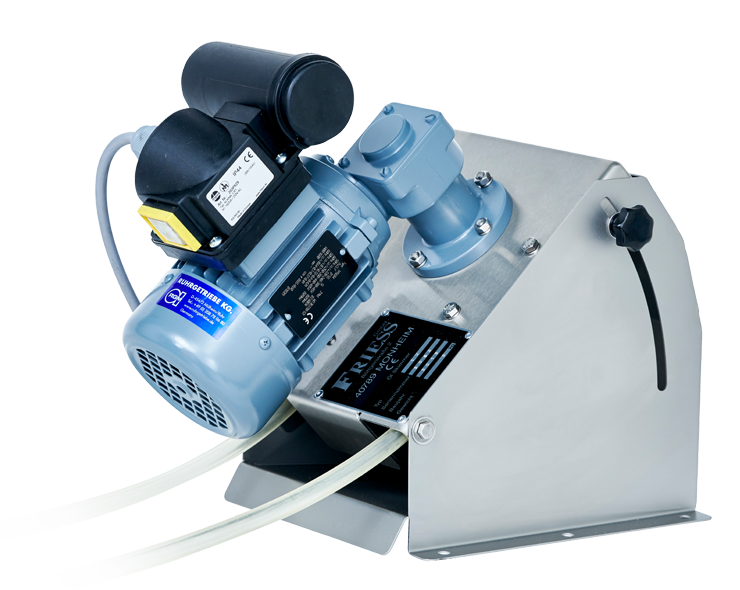
For emulsion tanks and small degreasing plants.
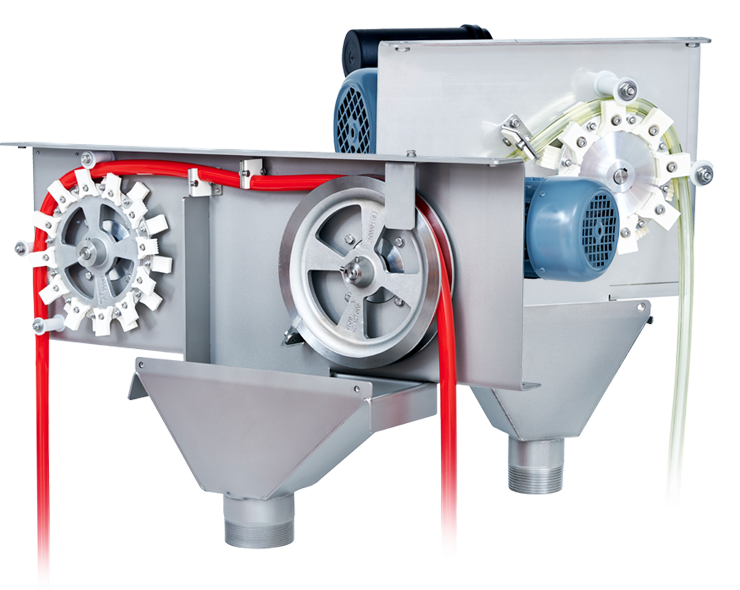
Designed for large tanks with fluctuation in fluid levels.
Different Variants of the Hose Skimmer
Depending on the container (size, shape, width), the skimmer may vary in type or model. Sufficient hose length ensures that floating foreign oils are collected even from the far corners of the tank, such as in coolant systems. The hose can reach farther areas of the container. There are already several hose skimmer models available as standardized products, but it is always recommended to coordinate performance requirements and local conditions with the manufacturer to determine the best model.
Belt Skimmer Areas of Use
This type of oil skimmer is primarily intended for tanks with small surface areas. The belt dips into the liquids to be separated vertically or at an angle. Due to the design and operation of the belt skimmer, only a small surface area is effectively treated. This condition would lead to a reduction in effectiveness in larger tanks since only a small portion of the oil floating on the surface would be captured, as the oil would rarely flow towards the belt skimmer. For larger tanks or basins, the belt skimmer, as well as the disc skimmer, is unsuitable. For larger systems, the tube skimmer is the preferred choice. The length of the tube can be adjusted to fit the size of the basin, ensuring that no “dead areas” are created, and oil can be captured across the entire surface.
The Oil Intake Hose – The Heart of the Hose Skimmer
Not all hoses are suitable as oil intake hoses. To ensure that as much oil as possible adheres to the hose, the composition and surface design of the intake hose are specifically tailored. The exact formulation and surface design are usually proprietary secrets of the manufacturers. In addition to being able to absorb large amounts of oil, the hose must also be resistant to mechanical wear and physical and chemical influences. For example, temperatures in very high or low ranges can impact the intake capacity and lifespan. Aggressive chemicals can also damage the special plastic material.
The material of the intake hose should be designed to withstand a wide range of influences without premature material fatigue. The oil intake hose is a wear part that should be replaced after a certain period of continuous operation. Replacing the hose is usually easy and requires only a few steps. Therefore, hose skimmers are often low-maintenance and easy to operate.
Considerations:
The manufacturer of the hose skimmer should be able to provide fast replacement parts when necessary. This is particularly important if the oil intake hose has been damaged to the point where the skimmer must be taken out of operation. Extended downtimes usually lead to higher operating costs.
Advantages:
- The length of the oil intake hose can be selected to cover the entire surface of the basin.
- The movement of the intake hose creates a rotation on the liquid surface, actively moving the oil towards the hose.
- The intake hose floats on the water surface and works exactly at the oil/water interface, ensuring the oil adheres to the hose without being pulled below the surface, as in other systems.
Disadvantages:
- Often more expensive than other oil skimmers.
- Minimum surface area required for the hose intake to have enough space to spread out.
Conclusion:
Unlike the designs of belt skimmers, disc skimmers, or drum skimmers, the hose skimmer is not intended for very small tanks. Extremely cramped tanks also make it difficult for the hose skimmer to work, as it needs some space for the hose to spread out. However, the hose skimmer proves to be an ideal solution for larger tanks, where it can be flexibly adjusted to meet the requirements.
Hose skimmers are particularly suited for businesses with high throughput, requiring powerful oil separation capabilities. This design is commonly used in wastewater and cooling water treatment because large basins are needed, and these areas often experience heavy contamination.
Learn more about the different types of oil skimmers:
Ask us!
We offer advice on oil-water separation, coolant and cutting fluid maintenance, and wastewater pre-treatment. The right solution for every requirement. Intelligent environmental management and operational cost reduction go hand in hand with us.