
 Deutsch

Oil Skimmers as Belt Skimmers
Belt skimmers are arguably the most widely used type of oil skimmers in the industry. The belt skimmer consists of a motor with a drive pulley and a support. The drive pulley drives a flat, endless skimmer belt. Through a loose or guided deflection pulley, the belt is weighted or guided and pulled down. The lower part of the belt dips into the floating oil phase. The oil adheres to the belt and is first transported into the underlying water phase. The remaining oil adhering to the belt is then lifted and removed from the belt by scrapers and directed into a collection container.
Band skimmer examples

Classic belt skimmer
with endless belt
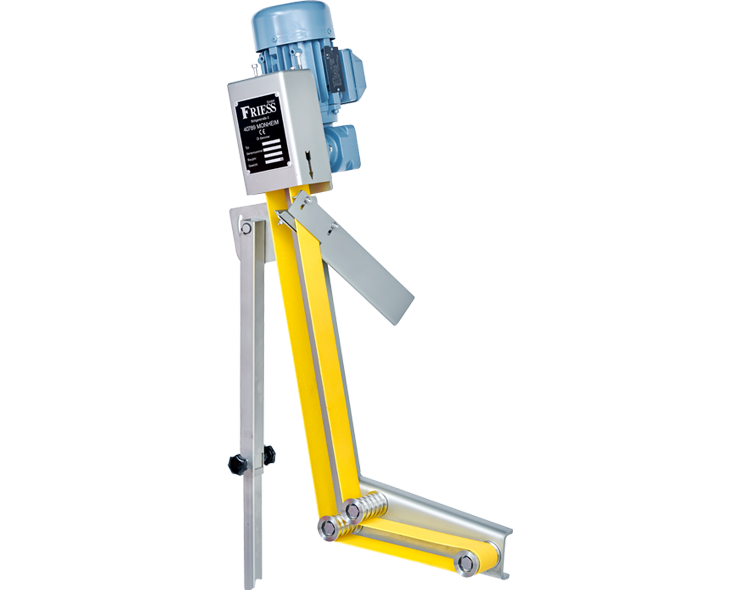
Band kimmer FRIESS WBS
with deflection rollers
For this type of skimmer, the removal rate of tramp oils largely depends on the width of the belt. There are also other factors, such as belt speed, which in turn depends on the performance of the motor driving the skimmer. Generally, the belt skimmer type is ideally suited for cleaning and maintaining all cooling lubricants, but only for small tanks, regardless of the version of the belt skimmer offered. Belt oil skimmers are easy to install and often come with a magnetic base as standard.
Application Areas
Belt skimmers are frequently used on machine tools to remove tramp oil from the cooling lubricant. They are particularly suitable for small emulsion systems. By removing tramp oil from the surface of the coolant, the formation of bacteria in the emulsion is hindered, and the coolant maintains operational parameters such as oil concentration and pH value for a longer time. This not only extends the service life of the cooling lubricant but also contributes to workplace health and safety.
Other application areas include washing applications such as degreasing baths, parts washers, or pre-treatment baths of painting systems. Oil removal is important in these applications to ensure that the cleaning performance of the washing liquid does not decline too quickly. The more saturated the washing liquid is with oil, the less oil it will remove. In these applications, the belt skimmer must be made from durable materials to achieve a reasonable lifespan. Only a few belt skimmers meet these criteria, which is why they are rarely used in these aggressive environments.
Belt Skimmer Areas of Use
This type of oil skimmer is primarily intended for tanks with small surface areas. The belt dips into the liquids to be separated vertically or at an angle. Due to the design and operation of the belt skimmer, only a small surface area is effectively treated. This condition would lead to a reduction in effectiveness in larger tanks since only a small portion of the oil floating on the surface would be captured, as the oil would rarely flow towards the belt skimmer. For larger tanks or basins, the belt skimmer, as well as the disc skimmer, is unsuitable. For larger systems, the tube skimmer is the preferred choice. The length of the tube can be adjusted to fit the size of the basin, ensuring that no “dead areas” are created, and oil can be captured across the entire surface.
Design
Belt skimmers are known for their very compact design, making them ideal for installation in already tightly packed tanks. They also fit through very small openings in tanks, which helps reduce heat loss in hot applications. Some belt skimmers even feature guided deflection pulleys, allowing them to be inserted sideways into a tank when top installation is not possible.
Prices
Belt skimmers are available for well under $1000 . Depending on the manufacturer and quality, belt skimmers can even be purchased for under $500. However, caution should be exercised, as such special offers often bring a lot of work with them due to issues arising from low quality.
In smaller tanks, they effectively remove oils, helping to keep coolants clean. This leads to a significantly longer service life and, therefore, sustainable reductions in operating costs. Depending on the intensity of use, the skimmer belt needs to be replaced at shorter or longer intervals, as it will show signs of wear from oil stripping after a while. The prices for a replacement belt vary by manufacturer and should be inquired beforehand. When comparing prices, factors such as warranty period, spare part costs, capacity, and performance should be considered.
The lifespan of a skimmer belt can vary greatly depending on the aggressiveness of the liquid, influenced by temperature and pH value. It is advisable to ask whether the manufacturer offers different belts designed for different operating conditions to minimize the frequency of replacements.
Summary
Belt skimmers are particularly suited for small applications. Due to their excellent cost-effectiveness, they are very popular for small machine tools and other small-scale applications and work very efficiently.
The only caution is that the application should not become too large. Otherwise, the belt skimmer may no longer be able to remove all the oil present.
Advantages
- Small and compact device
- Inexpensive
- Bath surface can fluctuate (large models may have significant fluctuations)
Disadvantages
- Low removal capacity
- Does not create surface flow
- Covers only a small area of the surface
- Often very labor-intensive
More about other types of oil skimmers:
Click here for more comprehensive information about belt skimmers.Ask us!
We offer advice on oil-water separation, coolant and cutting fluid maintenance, and wastewater pre-treatment. The right solution for every requirement. Intelligent environmental management and operational cost reduction go hand in hand with us.