
 Deutsch
How Oil Skimmers Work
The working principle of all types of oil skimmers is based on the same fundamental concepts—only the implementation differs.
All oil skimmers take advantage of oil’s higher viscosity to enable separation. Since oil adheres to foreign objects longer than water does, skimmers typically use structures to which the oil can stick. These structures can be belts, discs, tubes, or similar components, leading to different types of oil skimmers.
Essentially, the skimmer provides a surface where oil can accumulate. This surface moves continuously so that the oil is carried away from the water’s surface and scraped off into a collection container.
The key requirement for this process is that oil separates from water and floats on its surface, which occurs due to the difference in density between water and oil.
The most established models

Klassischer Bandskimmer
für kleine Tanks
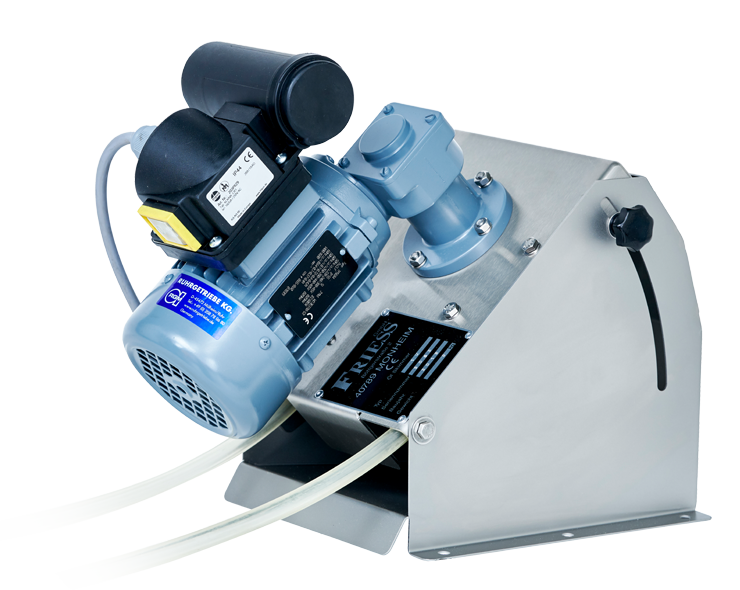
Schlauchskimmer für mehr Leistung und Flexibilität
Types of Oil Skimmers:
- Belt skimmers
- Disc skimmers
- Tube skimmers
- Belt-type skimmers
Why Oil Might Not Separate from Water
In some cases, oil may not separate properly from water or other liquids. This can be due to several factors:
- Chemical additives (emulsifiers) binding oil to water
- Turbulent liquid conditions preventing oil from settling
- Oil droplets too small to float to the surface
Solutions for Oil Separation Problems
2. The Liquid is Too Turbulent
If strong turbulence prevents oil from rising to the surface, the solution is to reduce movement so the oil can settle.
- If possible, turning off the system for a while may help.
- If continuous operation is required (e.g., in three-shift production), a portion of the liquid must be pumped into a separate tank where it can settle. This is where oil separators come into play, as they are designed for precisely this purpose.
3. Oil Droplets Are Too Small
If oil droplets are too tiny, their buoyancy force may not be strong enough to overcome the water’s internal resistance and rise to the surface.
- The solution is to merge small droplets into larger ones, a process known as coalescence.
- Coalescence is the act of merging smaller entities into a larger one. In this case, small oil droplets stick to a special surface, where they gradually combine into larger droplets.
- Once the droplets are large enough, they naturally rise to the surface. This process is facilitated by oil separators, also known as coalescence separators.
Ask us!
We offer advice on oil-water separation, coolant and cutting fluid maintenance, and wastewater pre-treatment. The right solution for every requirement. Intelligent environmental management and operational cost reduction go hand in hand with us.